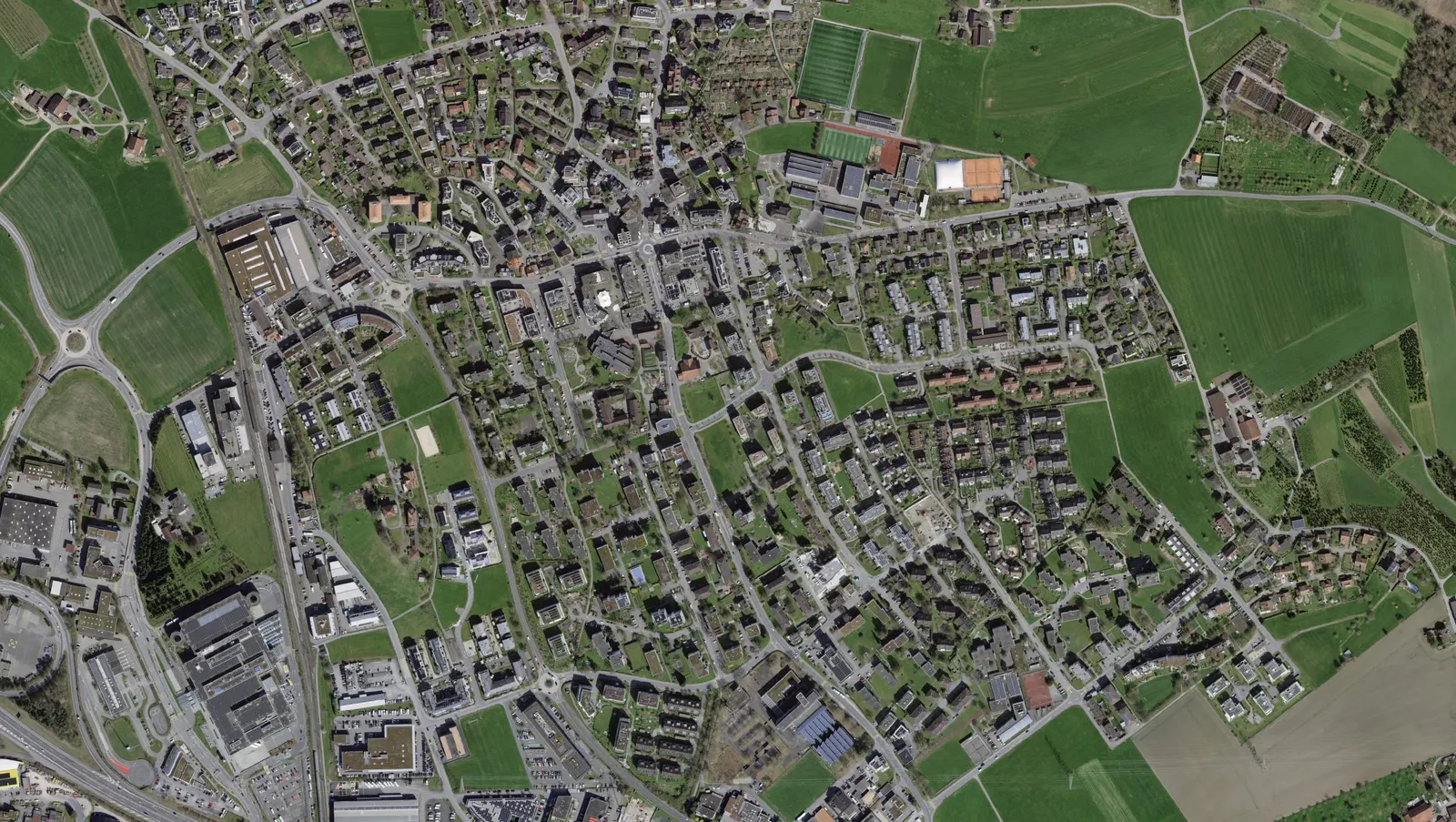

What leads owners in Steinhausen to sell?
Steinhausen is compact: 504 hectares between the city of Zug, Baar and Cham, the smallest area of any municipality in the canton. From the 1970s onwards the large residential quarters of Öli and Goldermatten, Eschen and Höf, Hasenberg and Freudenberg were built; 56% of the dwellings date from after 1981, and 63% have four or more rooms.
Four situations come up particularly often in Steinhausen:
- The terraced house (Reihenhaus) has become too big. What is wanted is a flat with a lift near the station and a sale timed to match the purchase.
- The parental home passes to the heirs. The community of heirs (Erbengemeinschaft) (in German) first needs a figure that everyone accepts.
- A renovation backlog meets a high market value. Invest before the sale, or offer the property as it is? That is decided by what buyers will pay, not by the renovation costs.
- The condominium flat (Stockwerkeigentum) with a renewal fund. Buyers and banks examine the regulations, the state of the fund and the renovations already resolved as closely as the flat itself.
In every case the work begins with a valuation that stands up to co-heirs, banks and buyers.
How tight is the housing market in Steinhausen in 2026?
The canton publishes no price statistics at municipal level; the property market cockpit of the Office for Data and Statistics (Fachstelle für Daten und Statistik; data by Wüest Partner, as at the first quarter of 2026) covers the Zug region: median price paid for flats CHF 17,959 per square metre (362 transactions up to the first quarter of 2026); in the first quarter of 2026 only 95 detached houses (Einfamilienhäuser) and 188 flats were advertised across the whole region. Steinhausen itself in official figures:
| Steinhausen in figures | Value | Source |
|---|---|---|
| Resident population on 31 December 2025 | 10,449 residents (+0.5% on 2024; 2015–2025: +9.5%) | Zug Statistics Office (BFS) |
| Municipal area | 504 ha, the smallest municipality in the canton by area; 40.7% settlement area | Zug in Zahlen 2025 |
| Dwellings and buildings | 4,738 dwellings (2025); 415 detached houses, 440 apartment buildings (2023) | Zug in Zahlen 2025 |
| Construction periods | 56% of dwellings built after 1981; 63% with 4+ rooms | Neighbourhood analysis 2021 (GWS 2018) |
| Renting | 65.9% of households; 31.4% owner-occupied (1,421 of 4,532, period 2022–2024) | Open Data Canton of Zug (BFS structural survey) |
| Vacant dwellings on 1 June 2026 | 6 dwellings, vacancy rate (Leerwohnungsziffer) 0.13% (2025: 10, 0.21%) | Open Data Canton of Zug |
| Municipal tax multiplier 2023 to 2026 | 56 → 54 → 54 → 53% | Zug Tax Administration |
For sellers this means: according to the neighbourhood analysis (Quartieranalyse), the settlement area has barely expanded since the 1970s; new houses with gardens are rarely built, and existing ones are in demand. Two thirds of the population rent; in the experience of Rudat AG, a large share of the buyers of terraced and detached houses come from these households, alongside commuters to Zurich and investors. From June to mid-September 2026, 170 buyer enquiries came in through the portals.
The Zug Sales Matrix 2026 (in German) compares Steinhausen with every other municipality in the canton, each figure from an official source.
Steinhausen in 2030: what is changing
Values as a table
| Year | Residents |
|---|---|
| 1850 | 490 |
| 1900 | 443 |
| 1950 | 1,078 |
| 2000 | 8,801 |
| 2016 | 9,735 |
| 2025 | 10,449 |
| 2040 (structure plan) | 11,200 |
Steinhausen has what most municipalities only promise: a local plan in force since 2 April 2026, a spatial strategy (Räumliche Strategie) 2040 that is binding on the authorities, an approved transport structure plan and three centre sites on which demolition has begun or the plans are on the table. Added to this is the cantonal structure plan (Richtplan) with target values up to 2040. Together, these documents show fairly precisely what Steinhausen will look like in 2030: denser in the centre, unchanged in the detached-house quarters, without a single high-rise building.
The local plan of 2025: inward growth, no high-rise buildings
On 29 June 2025 the voters approved all four proposals of the local planning revision (Ortsplanungsrevision): the new building regulations with zoning plan (Zonenplan und Bauordnung) by 1,169 votes to 442 (72.6%), the designation of the watercourse corridors (1,198 to 398), the parking regulations (923 to 673) and the road regulations (1,047 to 554); turnout was 26.5%. The cantonal government (Regierungsrat) approved the plan on 10 March 2026, and it has been in force since 2 April 2026. It was preceded by a seven-year process with a core group and an advisory group drawn from the population, which began in spring 2018 and led to the spatial strategy 2040 on 12 April 2021.
Three provisions shape the housing market. First: Steinhausen grows within the existing building zones, by filling gaps, adding storeys and replacing buildings; the strategy aims for annual population growth of 0.6 to 0.8% up to 2040, to around 11,200 to 11,800 residents, with the population not to exceed the number of jobs. Second: high-rise buildings are not permitted in any zone (§ 13 of the building regulations); the strategy rules out buildings above 30 metres and allows taller buildings only in one designated area. Third: for ordinary development plans (Bebauungsplan) the municipal council can require a share of affordable housing (preisgünstiger Wohnraum) (§ 12), and on rezoning and upzoning the municipality levies a value-added levy (Mehrwertabgabe) of 20% of the increase in land value (§ 36). The detached-house quarters Hasenberg, Freudenberg, Eschen and Höf count in the strategy as «stable areas» in which the zoning in force is retained.
The centre sites: 276 flats in planning
- The Park on the Crypto site on Zugerstrasse: on the grounds of Crypto AG, founded in 1952 and dissolved in 2018, 227 flats are being built in ten buildings, 38 of them affordable with 1.5 to 5.5 rooms (at least 15% of the usable floor area permanently affordable), plus two kindergartens and commercial space. The quarter is planned car-free, with 317 parking spaces in the underground car park. The municipal assembly approved the development plan at the end of 2021, and the building application was submitted in 2023 with an investment volume of around CHF 100 million. Empira AG has been the owner since 2025; demolition from May 2026, construction starting in autumn 2026, completion in 2029.
- Pöstli, Zugerstrasse 2 and 4: Alfred Müller AG is replacing the post office building in the village centre with a new building of 28 rental flats with 2.5 to 5.5 rooms, a post office branch and a café on the ground floor; the design of the outdoor space is being coordinated with the municipality's upgrading of the village centre (as at March 2026).
- Eichholzstrasse 13: on the cantonal plot of the former Eichholz residential home, the housing cooperative awzug is building 21 flats with 2.5 to 5.5 rooms under a building lease (Baurecht), two thirds of them under the cantonal Housing Promotion Act; the municipal council issued the simplified development plan on 10 January 2022.
- By the station: for the commercial site south of the station with the municipal works yard and recycling centre, the municipality selected the project «Trittico» by Ballmoos Partner Architekten and Neuland Architektur Landschaft (Zurich) from 28 entries on 3 July 2024. Planned are municipal works, commercial space and partly affordable flats; the voters approved the CHF 265,000 credit for the design study in June 2023, with construction provisionally starting in 2029.
The centre and the station are to be linked through the municipal transport structure plan (issued on 3 April 2023, approved by the canton on 29 September 2023): Bahnhofstrasse and Zugerstrasse are to be turned from traffic-oriented road space into places to linger, a reduced-speed zone is being examined for Zugerstrasse, and the station is to be rebuilt as a multimodal hub with direct access to the station square. For the schools, the municipal assembly resolved on 26 June 2025 to add two storeys in timber construction to the Sunnegrund 5 school building (construction from the spring holidays of 2026 to the autumn holidays of 2027, 20 classrooms thereafter), and from the 2025 surplus of CHF 5.5 million, CHF 3 million goes into pre-financing the renovation of the Feldheim school campus.
The structure plan: 11,200 residents by 2040, and Steinhausen is ahead
The cantonal structure plan expects 11,200 residents in Steinhausen in 2040 (baseline 2016: 9,735) and 10,600 jobs (baseline 2014: 8,618). Read linearly, the population path gives around 10,280 for 2025 and around 10,590 for 2030; with 10,449 residents, Steinhausen is already about 170 people above the path. Put differently: the level the canton expects for 2030, Steinhausen reaches in one step with the 227 flats on the Crypto site. For jobs the road is longer: 9,016 employees in 2023 are around 1,600 below the target of 10,600; the reserve for this lies in the employment areas Hinterberg, Sumpf, Sennweid and Rigiblick, which according to the municipality form the largest reserves of employment zones in the whole canton. Our assessment: at an average of 2.2 people per dwelling (10,449 residents, 4,738 dwellings), Steinhausen needs around 340 additional dwellings to reach the structure plan value by 2040, and around 610 for its own upper limit of 11,800. The three centre sites deliver 276. The rest comes, as the local plan intends, from adding storeys and replacing buildings in the existing stock, not from new building land (Bauland). The cantonal government has announced that it will revise the forecasts in 2027 on the basis of the new scenario of the Federal Statistical Office (BFS).
What this means for owners in Steinhausen
- There is no new supply of building land. 504 hectares, 40.7% of them settlement area, a settlement boundary in the Lorze plain since 2004 and a local plan that grows exclusively inwards: the supply of plots in Steinhausen is fixed. With 6 vacant dwellings out of 4,738, every property that comes onto the market meets waiting buyers.
- Densification takes place in the centre, not in your quarter. The Park, Pöstli, Eichholz and the station site all lie in the triangle Zugerstrasse–station–Eichholzstrasse. The detached-house quarters are designated as stable areas, and high-rise buildings are ruled out. Anyone selling on Hasenberg, in the Höf or on Keltenweg is selling a location that will not be built like this again.
- For houses from the 1960s and 1970s, the land often counts for more than the house. The municipality's neighbourhood analysis identifies older buildings in need of renewal on Keltenweg, in Neudorf and on Eichholzstrasse, in the residential zones W3 and W4 with «moderate densification potential». That is why, for buildings from before 1980 in Steinhausen, we always value two routes, continued occupation and replacement, and approach developers from our network specifically.
- The flat for downsizing is being built right now. 276 new flats in the centre, with lift, post office, café and station within walking distance, come onto the market from 2027 to 2029. For owners of a terraced or detached house this means: the sale of the house and the move into a flat in the centre can be planned in time, and until then there is no new-build competition in your own price segment.
This assessment is our reading of the official figures and not a promise of price. What your property is worth in this environment is shown by the valuation, free of charge and using the models that banks use.
Steinhausen in fast forward
- c. 8000 BCThe oldest traces: Mesolithic finds in Hinterberg and Neolithic lakeshore settlements in Sennweid, on what was then the more northerly shore of Lake Zug.
- 858Steinhausen probably passes to the Fraumünster abbey in Zurich as part of the Cham estate; later St. Blasien, Muri and Kappel are also landlords.
- 1173First documentary mention as «Steinhusin», together with a chapel of the monastery of St. Blasien.
- 1430Zug and Zurich draw the high-court boundary straight through the village, valid until 1798; from 1438 to 1485 the city of Zug buys up the rights over Steinhausen.
- 1550Construction of the so-called castle on the Schlossberg, seat of the Zug bailiffs; since 1920 it has housed the Maria Hilf mission house of the Steyler missionaries.
- 1611The chapel is raised to the parish of St. Matthias; until then Steinhausen belonged to Baar for church purposes.
- 1798The city of Zug gives up the bailiwick: Steinhausen becomes an independent municipality. Tithes and the right of patronage are bought out by 1808.
- 1904Steinhausen receives a station on the Zurich–Zug railway line built in 1864. In 1900 the farming village still counts 443 residents.
- 1953First building regulations and zoning plan. Between 1950 and 2000 the population grows from 1,078 to 8,801, an eightfold increase.
- 1979Motorway junction and opening of the Zugerland shopping centre on 28 September; Steinhausen becomes part of the Zug agglomeration.
- 2012–2017The Steinhausen Rigiblick stop (2012) and the Dreiklang centre with municipal hall, library, shops and 38 flats on Weihermattplatz (2017).
- 2025Yes to the new local plan with 72.6% on 29 June and to the extension of the Sunnegrund 5 school building on 26 June; Empira AG buys the Crypto site.
- 2026Local plan in force (2 April), the Lorze plain becomes Landscape of the Year, demolition on the Crypto site and start of construction of The Park in the autumn.
- 2029Completion of The Park with 227 flats; provisional start of construction for «Trittico» by the station.
- 2040The canton's target value: 11,200 residents; the municipality is aiming for 11,200 to 11,800.
What makes Steinhausen special
Steinhausen lies north of the city of Zug, bordering Baar to the east, Cham to the west and the canton of Zurich to the north; the neighbourhood analysis (Quartieranalyse) calls it an «urban village» with around 9,000 jobs. The quarters are clearly distinct:
- Zentrum, Kirchmatt, Schlossberg and Bahnhof: apartment buildings (Mehrfamilienhäuser) on Kirchmattstrasse, new residential buildings by the station; the flats that house owners move into after the sale.
- Öli and Goldermatten: a dense quarter made up almost entirely of apartment buildings, close to the village centre.
- Hasenberg, Freudenberg, Keltenweg, Neudorf: quarters of detached and semi-detached houses in the north; many renovated houses on Hasenberg, older ones on Keltenweg.
- Eschen, Vorder- and Hinterhöf: half detached houses, half apartment buildings, many families, renovation potential along Eichholzstrasse.
- Rigiblick, Sennweid, Hinterberg, Sumpf: offices, trade and industry, the Zugerland shopping centre, the Rigiblick stop and the motorway junction; the Sunnegrund school campus in Eschfeld.
The municipal tax multiplier (Steuerfuss) stands at 53% of the simple tax in 2026, three points below 2023.
The stations Steinhausen and Steinhausen Rigiblick lie on the S5 line from Zug to Zurich main station (Zürich HB) with a half-hourly service: 6 minutes to Zug (5 from Rigiblick), 40 minutes to Zürich HB without changing, 33 minutes to Lucerne with a change in Zug. Bus routes 606, 616 and 636 connect to Zug, Cham and Baar; the motorway forms the southern municipal boundary, with the junction by the Zugerland.
The Steinhausen school teaches around 1,040 children with around 160 teachers: nine kindergartens, the Sunnegrund primary school and the Feldheim lower secondary school; the Kantonsschule Zug, the cantonal grammar school, is on Lüssiweg in the city of Zug.
Economically, Steinhausen is more than a place to live: since 1963 Hapimag, the holiday-ownership community with 56 resorts and over 5,000 holiday apartments across Europe, has had its head office on Sumpfstrasse; Transocean and Carlo Gavazzi Holding are domiciled in the municipality, Swisspor manufactures north of the station, and the cantonal Road Traffic Office and the Office for Civil Protection and Military are based in Hinterberg. From 1952 to 2018 Steinhausen was the seat of Crypto AG, whose site on Zugerstrasse is now becoming a residential quarter. According to the spatial strategy (Räumliche Strategie) 2040, Steinhausen has the largest reserves of employment land in the whole canton; the BusinessPark Zug, the canton's start-up centre, also stands on Steinhausen soil. The 2025 accounts closed with a surplus of CHF 5.5 million instead of the budgeted deficit of CHF 1.9 million, mainly thanks to higher corporate taxes.
Steinhausen comes to life at the Waldstock Open Air, at carnival (Fasnacht) under the ibex of its coat of arms, at the Grümpelturnier football tournament and the village festival, in the library and in the municipal hall of the Dreiklang. The municipal transport structure plan (Verkehrsrichtplan) of 2023 aims to link the centre and the station with a continuous pedestrian axis, to introduce traffic-calmed zones throughout and to create safe cycle routes to the neighbouring municipalities and to Lake Zug; the motorway junction has been right by the Zugerland since 1979, and Zurich and Lucerne are around 20 minutes away by car.
Districts and locations in Steinhausen
Every district has its own market and its own buyers. That is why we do not work with an average price in Steinhausen, but with comparable properties from the same district.
Zentrum, Kirchmatt, Schlossberg and Bahnhof
The administrative, cultural and shopping centre around the village roundabout, Weihermattplatz and the church of St. Matthias, with the oldest houses in the village and many renovated buildings; apartment buildings on Kirchmattstrasse, new residential buildings east of the station. The Park, the Pöstli and the station site are concentrated here; the neighbourhood analysis sees the municipality's greatest development and densification potential here, expressly without high-rise buildings.
Flats of all construction years, residential and commercial buildings, new-build flats from 2027, apartment buildings as investments.
Öli and Goldermatten
Steinhausen's densest residential quarter, almost exclusively apartment buildings from the 1970s and later, 75 to 100% built out, richly planted and a few minutes' walk from the village centre. The municipality wants to make the renewal of the apartment buildings possible here and sees high densification potential.
Flats from the 1970s to 1990s, apartment buildings with replacement potential.
Hasenberg and Freudenberg
The north towards the Steinhauserwald: more detached houses than apartment buildings, a younger to middle-aged population, many renovated or new buildings, listed farmhouses on Freudenberg and on Bannstrasse. In the spatial strategy a stable area in which the zoning remains.
Detached and semi-detached houses with gardens, terraced houses, individual farmhouses with land.
Keltenweg and Neudorf
A residential quarter close to the centre between Bannstrasse and Knonauerstrasse, with older semi-detached houses in the west and apartment buildings in the east, a rather older population and moderate building activity. The municipality wants to make the renewal of the semi-detached houses possible; the neighbourhood analysis speaks of moderate densification potential.
Semi-detached houses from the 1960s and 1970s in need of renewal, flats, plots with replacement potential.
Eschen, Vorder- and Hinterhöf
The family quarter in the east, half detached houses and half apartment buildings, a low to medium average age, new development in Hinterhöf, renewal potential along Eichholzstrasse. The largest building land reserves in the settlement area lie here (Vorderhöf around 31,400 m², Hinterhöf around 15,200 m²) and are subject to a development plan requirement.
Detached and terraced houses from the 1970s to 1990s, family flats, plots subject to a development plan.
Rigiblick, Sennweid, Hinterberg and Sumpf
The employment areas south of the railway line as far as the motorway: office buildings on Sumpfstrasse with the head office of Hapimag, the Zugerland shopping centre, the Road Traffic Office and the Office for Civil Protection in Hinterberg, the Rigiblick stop since 2012 and the motorway junction. With the largest reserves of employment zones in the canton; the Sumpf–Chollerstrasse area is to become a residential and employment area together with the Äussere Lorzenallmend of the city of Zug.
Commercial and office properties, living combined with commercial use, individual apartment buildings; income-producing properties for investors.
Experience Steinhausen: places that win buyers
Whoever buys in Steinhausen also buys a setting. We name these places in every sales documentation, because they make the difference between an address and a home.
- SchlossbergThe hill between the centre and the station with the «castle» built in 1550, once the seat of the Zug bailiffs; since the purchase of the Maria Hilf property in November 1920, home of the Steyler missionaries. The spatial strategy 2040 calls the Schlossberg Steinhausen's defining feature and safeguards it as a space for recreation and biodiversity.
- Parish church of St. Matthias with ossuaryThe chapel of the monastery of St. Blasien, first mentioned in 1173, became the parish church of St. Matthias in 1611; until then Steinhausen belonged to the parish of Baar. The church and ossuary on Zugerstrasse are protected as a cultural asset of regional importance.
- Dreiklang and WeihermattplatzThe centre built from 2015 to 2017 by Müller Sigrist Architekten combines a municipal hall, library, shops and 38 flats around a new village square (construction cost CHF 58 million). From here the axis along Bahnhofstrasse leads to the station, which the transport structure plan intends to turn into a promenade.
- Steinhauserwald and pondThe forest in the north of the municipality with the pond created in the 1970s: a circular walk from the centre via Bann, Sebeliboden and Bannäbni in around 1 hour 40 minutes, suitable for pushchairs, with fire pits, a playground and the soil trail; in winter the path around the frozen pond becomes a walk in the snow.
- Lorze plainThe unbuilt plain between Steinhausen, Zug, Baar and Cham has been protected by a settlement boundary in the structure plan since 2004 and was named Landscape of the Year by the Swiss Foundation for Landscape Conservation on 15 April 2026: a green lung that has remained unbuilt despite 34% population growth since 2000.
- Zugerland shopping centreOpened on 28 September 1979 by the Migros Lucerne cooperative and extended from 2005 to 2007 to 22,712 m² of retail space with 51 shops, the third-largest shopping centre in Central Switzerland, right by the Rigiblick stop and the motorway junction.
- Waldstock Open AirFounded in 2000 by young people from Steinhausen, the festival on the edge of the forest draws around 5,000 visitors over three days at the beginning of August each year, with music, show and comedy, and belongs with carnival, the Grümpelturnier football tournament and the village festival to the fixed annual calendar.
- Bann and ErliThe two hamlets outside the building zone in the north: agricultural in character, with equestrian sport, listed farmhouses, standard fruit trees and the park-like Erli cemetery. The municipality deliberately keeps them at their present size; no new buildings are planned here.
Who sells my house or flat in Steinhausen?
Rudat AG works from Neuhofstrasse 5A in Baar; Steinhausen is the neighbouring municipality. Owner Conrad Rudat leads every mandate personally through to notarisation (Beurkundung).
First the figure. We value with the IAZI/CIFI models used by Swiss banks, see methods (in German), and check the result against the property: condition, land register (Grundbuch) and, for condominium ownership (Stockwerkeigentum), the regulations and renewal fund; for houses from the 1970s to 1990s we openly factor in the renovation requirement. The valuation is free of charge and without obligation for owners in Steinhausen.
Then the stage. Valued like a bank. Marketed like a boutique. Every property receives its own sales documentation with photographs, drone footage and floor plans; we furnish empty rooms with home staging, and a 360° virtual tour (in German) filters the prospective buyers. The property is listed on the major Swiss portals and offered to our network of buyers and investors; we handle viewings, financing checks and negotiation.
Documented, not claimed. In Aesch LU we are currently marketing a 6.5-room mid-terrace house with garden, the property type typical of Steinhausen; in Affoltern am Albis we sold a 4.5-room garden flat in 2026 (20 portal enquiries up to September 2026). A house in Uster (in German) was sold after 48 hours, a flat in Schattdorf within 4 weeks and a flat in Hochdorf after 12 weeks. 12 sales are documented, and Google shows 5.0 stars from 26 reviews (references).
Read on: the process (in German), costs, property gains tax; neighbouring municipalities Zug, Baar, Cham; overview Canton of Zug. First conversation: contact us or +41 41 763 33 66.
This text is no substitute for tax or legal advice; on request we involve a fiduciary and the notarising officer.
Sources
Show sources (55, in German)
- Steuerverwaltung Kanton Zug – Steuerfüsse der Gemeinden des Kantons Zug für die Steuerjahre 2023–2026 (PDF, 21.01.2026, am gerenderten Bild geprüft): Steinhausen 56 / 54 / 54 / 53 % (2024 und 2025: 56 % mit Rabatt 2 %, 2026: 56 % mit Rabatt 3 % des Einheitsansatzes), Kanton 80 / 82 / 82 / 78 %, katholische Kirchgemeinde Steinhausen 9 %, reformiert 2026 6 %; Vergleich 2026 Zug 52, Baar 47,53, Cham 54, Hünenberg 53, Risch 54, retrieved 28.09.2026
- Fachstelle für Daten und Statistik Kanton Zug – Ständige Wohnbevölkerung nach Gemeinde, Kanton Zug 1850 bis 2025 (XLSX, Datenquelle BFS STATPOP): Steinhausen 2015 = 9’543, 2024 = 10’399, 2025 = 10’449; Kanton 2025 = 135’018, retrieved 28.09.2026
- Fachstelle für Daten und Statistik Kanton Zug – Bevölkerungsstand (Kanton 135’018 Personen, +0,96 % 2024–2025), retrieved 28.09.2026
- Gemeinde Steinhausen – Fakten und Zahlen (Einwohner per 30.06.2026: 10’671; Gemeindefläche 504 ha; Steuerfuss 56 % mit 3 % Rabatt), retrieved 28.09.2026
- Fachstelle für Daten und Statistik Kanton Zug – Wohnungen (Leerwohnungsziffer 1. Juni 2026: Kanton 0,2 %, 126 Wohnungen, Neuheim 0,09 %, Risch 0,32 %; Anteil Personen zur Miete: Steinhausen 65,9 %, Kanton 64,1 %; 62’760 Wohnungen im Kanton 2025), retrieved 28.09.2026
- Fachstelle für Daten und Statistik Kanton Zug / Zuger Kantonalbank – Der Kanton Zug in Zahlen, Ausgabe 2025 (PDF): Gemeindeporträt Steinhausen (Wohnungen 2023: 4’657), Gebäudebestand 2023 (415 Einfamilienhäuser, 440 Mehrfamilienhäuser), Flächen 2016 (504 ha, 40,7 % Siedlungsfläche), retrieved 28.09.2026
- Gemeinde Steinhausen – Grundlagenbericht zur Orts- und Quartieranalyse, R+K Büro für Raumplanung AG, 12.04.2021 (PDF): Bauperioden, Gebäude- und Wohnungsbestand (GWS 2018: 4’393 Wohnungen, 56 % nach 1981, 63 % mit 4+ Zimmern), Quartiere A–M, «urbanes Dorf», Autobahn um 1979, Autobahnanschluss Hinterberg, retrieved 28.09.2026
- Fachstelle für Daten und Statistik Kanton Zug – Immobilienmarkt-Cockpit Kanton Zug (Daten Wüest Partner, Stand 1. Quartal 2026, XLSX; Blatt «Abschluss»: Median CHF 17’959/m², 362 Beobachtungen; Blatt «Mengen»: 95 Einfamilienhäuser und 188 Eigentumswohnungen im 1. Quartal 2026), retrieved 28.09.2026
- Schule Steinhausen – Schulangebot (rund 1’040 Kinder und Jugendliche, rund 160 Lehrpersonen, Primarschule Sunnegrund, Sekundarstufe I Feldheim, neun Kindergärten), retrieved 28.09.2026
- Kantonsschule Zug – Gymnasium und Wirtschaftsmittelschule, Lüssiweg 24, 6302 Zug, retrieved 28.09.2026
- SBB-Fahrplan, Abfrage für Montag, 29.09.2026, ab 08:00 Uhr (Datenabruf über transport.opendata.ch): S5 Steinhausen–Zug 6 Min., Steinhausen Rigiblick–Zug 5 Min., Steinhausen–Zürich HB 40 Min. direkt, Rigiblick–Zürich HB 42 Min., Steinhausen–Luzern 33 Min. mit Umstieg; Halbstundentakt, retrieved 28.09.2026
- Zugerland Verkehrsbetriebe – Fahrplan 2026, Linie 606 Zug–Steinhausen–Cham (gültig ab 14.12.2025); Linien 616 Zug–Steinhausen Zugerland und 636 Baar Bahnhof–Steinhausen Sennweid, retrieved 28.09.2026
- Wikipedia – Steinhausen ZG (Nachbargemeinden Knonau, Kappel am Albis, Baar, Zug, Cham; Autobahn A14 als südliche Gemeindegrenze; Haltestelle Steinhausen Rigiblick seit 2012; Buslinien 606, 616, 636 nach ZVB-Fahrplan), retrieved 28.09.2026
- Wikipedia – Autobahn 14 (Schweiz): Abschnitt Blegi–Sihlbrugg seit 2020 Nationalstrasse (vorher A4a), Anschlüsse Cham, Zug, Baar, retrieved 28.09.2026
- Steuergesetz des Kantons Zug vom 25. Mai 2000 (BGS 632.1), §§ 187–202 Grundstückgewinnsteuer (Satz, Besitzesdauer, Freigrenze, Aufschub §§ 190–191, Depot, Steuererklärung § 200), retrieved 28.09.2026
- Gesetz über den Gebührentarif im Grundbuchwesen des Kantons Zug (BGS 215.35), § 14 Abs. 3 (CHF 180 pro Stunde, Faktor 4 bis CHF 6’000), retrieved 28.09.2026
- Beurkundungsgesetz des Kantons Zug (BGS 223.1), § 4 Abs. 2 und § 7 Abs. 2 (Gemeindeschreiberei beurkundet Grundstückkaufverträge, Anwälte nicht), retrieved 28.09.2026
- Eidgenössische Steuerverwaltung ESTV – Dossier Steuerinformationen «Handänderungssteuer» (Kanton Zug erhebt keine Handänderungssteuer), retrieved 28.09.2026
- Rudat AG – Referenzen (Uster 48 Stunden, Schattdorf 4 Wochen, Hochdorf 12 Wochen, Affoltern am Albis 2026; Google 5,0 Sterne aus 26 Bewertungen; 12 belegte Verkäufe; 170 Käuferanfragen Juni bis Mitte September 2026), retrieved 28.09.2026
- Rudat AG – Objekt Aesch LU, 6,5-Zimmer-Reihenmittelhaus Vorderdorf 11 (in Vermarktung), retrieved 28.09.2026
- Kanton Zug Open Data – Leerstehende Wohnungen nach Gemeinde 1995–2026 (CSV): Steinhausen 1. Juni 2026 6 Wohnungen, 2025 10, retrieved 28.09.2026
- Kanton Zug Open Data – Leerwohnungsziffer nach Gemeinde 1995–2026 (CSV): Steinhausen 2026 0,13 %, 2025 0,21 %, retrieved 28.09.2026
- Kanton Zug Open Data – Eigentumsverhältnis der Haushalte nach Gemeinde (CSV, Daten BFS Strukturerhebung, Periode 2022–2024): Steinhausen 539 Hauseigentümer, 882 Stockwerkeigentümer, 2’987 Mieter von 4’532 Haushalten, retrieved 28.09.2026
- Kanton Zug Open Data – Wohnungen nach Zimmerzahl je Gemeinde (CSV, Daten BFS GWS): Steinhausen 2025 4’738 Wohnungen (2023: 4’657), retrieved 28.09.2026
- Historisches Lexikon der Schweiz – Artikel «Steinhausen» (Renato Morosoli, Version 13.11.2012): Bevölkerung 1771–2000 (1850 490, 1900 443, 1950 1’078, 2000 8’801), Ersterwähnung 1173, Fraumünster 858, Hochgerichtsgrenze 1430, Schloss 1550, Pfarrei St. Matthias 1611, Vogtei bis 1798, Bahnstation 1904 an Linie 1864, erste Bauordnung 1953, Autobahnanschluss 1979, Einkaufszentrum, retrieved 08.10.2026
- zentralplus – «Steinhausen stimmt Vorlagen zur Ortsplanungsrevision zu» (29.06.2025): Bauordnung/Zonenplan 1’169 zu 442, Gewässerraum 1’198 zu 398, Parkplatzreglement 923 zu 673, Strassenreglement 1’047 zu 554, Stimmbeteiligung 26,5 % (Paywall; Zahlen aus Suchauszug), retrieved 08.10.2026
- nau.ch / Gemeinde Steinhausen – «Steinhausen schliesst Ortsplanungsrevision ab» (18.06.2026): Urnenabstimmung 29.06.2025, Genehmigung Baudirektion/Regierungsrat 10.03.2026, Rechtskraft Bauordnung und Zonenplan 02.04.2026, Inhalte (Innenentwicklung, preisgünstiger Wohn- und Gewerberaum, Biodiversität, Klima, Hochwasserschutz), retrieved 08.10.2026
- Gemeinde Steinhausen – Bauordnung (BO) vom 29. Juni 2025, Stand 2. April 2026 (Rechtssammlung 7.1-1, ÖREBlex): § 12 preisgünstiger Wohnungsbau, § 13 «Hochhäuser sind in keiner Zone zulässig», § 36 Mehrwertabgabe 20 %, retrieved 08.10.2026
- Gemeinde Steinhausen – Ortsplanungsrevision (Übersichtsseite): Start Frühjahr 2018, Kern- und Begleitgruppe, Urnenabstimmung 29.06.2025, retrieved 08.10.2026
- Gemeinde Steinhausen – Räumliche Strategie 2040 (R+K Büro für Raumplanung, Gemeinderat 12.04.2021, PDF): Ziel W2 0,6–0,8 % Wachstum auf 11’200–11’800 Einwohner bis 2040, W3 Bevölkerung nicht über Beschäftigten, S4 keine Hochhäuser über 30 m, S5 Areale Hinterberg/Bahnhof/Crypto, stabile Gebiete, grösste Arbeitszonenreserven des Kantons, Schlossberg als prägendes Merkmal, Weiher und Friedhof Erli 1970er-Jahre, retrieved 08.10.2026
- Gemeinde Steinhausen – Grundlagenbericht zur Orts- und Quartieranalyse (R+K, 12.04.2021, PDF): Quartiere A–M mit Charakter, Baulandreserven (Vorderhöf 31’400 m², Hinterhöf 15’200 m², Schlossberg 27’600 m²), Verdichtungspotenzial, «keine Hochhäuser» im Zentrum, Bahnlinie 1864, Verlegung Lorze 1976, Autobahn 1979, Bevölkerung 1995 7’900 / 2017 9’900, Beschäftigte 1995 4’200 / 2017 9’000, retrieved 08.10.2026
- Gemeinde Steinhausen – Kommunaler Verkehrsrichtplan, Richtplantext (R+K, erlassen 03.04.2023, genehmigt Amt für Raum und Verkehr 29.09.2023, PDF): Hauptziele V3 Aufwertung Zentrum–Bahnhof und multimodale Drehscheibe, V4 Aufwertung/temporeduzierte Zugerstrasse, V5 flächendeckende Verkehrsberuhigung, Massnahmen 6.2 und 6.3, retrieved 08.10.2026
- Gemeinde Steinhausen – Mehrjahresziele 2024 bis 2027 (Gemeinderat 11.12.2023, PDF): Crypto-Areal, Aufstockung Sunnegrund 5, Planungswettbewerb Schulanlage Sunnegrund, Sanierung Feldheim, Verkehrsrichtplan, Unabhängigkeit vom Finanzausgleich, retrieved 08.10.2026
- Schule Steinhausen – Eckwerte zur Aufstockung des Schulhauses Sunnegrund 5 (Merkblatt 12.08.2025, PDF): Beschluss Gemeindeversammlung 26.06.2025, zwei Geschosse in Holzbauweise, Bauzeit Frühlingsferien 2026 bis Herbstferien 2027, ab Herbst 2027 20 Klassenzimmer, Minergie, retrieved 08.10.2026
- zug4you / Gemeinde Steinhausen – «From Crypto site to residential quarter» (24.04.2026): The Park Steinhausen, Empira AG (Kauf 2025), 227 Wohnungen in zehn Gebäuden, 38 preisgünstig (1,5–5,5 Zimmer), mindestens 15 % der Nutzfläche preisgünstig, zwei Kindergärten, Gewerbe, autofrei, 317 Tiefgaragenplätze, Abbruch Mai 2026, Baustart Herbst 2026, Fertigstellung 2029, Bebauungsplan Gemeindeversammlung Ende 2021, retrieved 08.10.2026
- zentralplus – «Megaprojekt: Hier entstehen 227 brandneue Wohnungen» (2026): The Park auf dem Crypto-Areal, Empira AG, Baustart Herbst 2026 (Paywall; Zahlen aus Suchauszug), retrieved 08.10.2026
- Immobilien Business – «Steinhausen (ZG): Building permit for ‹Crypto Areal› expected in the first half of the year» (27.02.2023): Baugesuch eingereicht, Investitionsvolumen CHF 100 Mio., Architekten Axess Architects und Leutwyler Partner, retrieved 08.10.2026
- zug4you / Alfred Müller AG – «28 new apartments to be built in the town centre» (13.03.2026): Neubau Pöstli Zugerstrasse 2 und 4, 28 Mietwohnungen 2,5–5,5 Zimmer, Postfiliale und Café, Abstimmung mit Aufwertung des Dorfzentrums, retrieved 08.10.2026
- Kanton Zug – Medienmitteilung «Kanton fördert günstigen Wohnraum» (28.10.2021): Eichholzstrasse 13 Steinhausen, 21 Wohnungen 2,5–5,5 Zimmer, zwei Drittel preisgünstig nach WFG, Auflage Bebauungsplan 05.11.–06.12.2021, Abgabe im Baurecht, retrieved 08.10.2026
- Kantonsrat Zug – Vorlage 3357.2 (Bericht und Antrag des Regierungsrats, 20.12.2022): einfacher Bebauungsplan Eichholzstrasse 13 erlassen am 10.01.2022, Baurecht an awzug (GV awzug 16.11.2022), zwei Drittel WFG-Wohnungen, retrieved 08.10.2026
- blue News / Keystone-SDA – «Steinhausen ZG kürt Siegerprojekt für Überbauung beim Bahnhof» (03.07.2024): Projekt «Trittico», Ballmoos Partner Architekten und Neuland Architektur Landschaft, 28 Bewerbungen, Ökihof, Werkbetriebe, Gewerbe, teilweise preisgünstige Wohnungen, Studienauftragskredit CHF 265’000 (Juni 2023), Richtprojekt bis Ende 2024, Baustart provisorisch 2029, retrieved 08.10.2026
- nau.ch / Gemeinde Steinhausen – «Steinhausen mit deutlichem Jahresplus» (28.04.2026): Rechnung 2025 +CHF 5,5 Mio. statt budgetiertem Minus von CHF 1,9 Mio., höhere Firmensteuern, Investitionen CHF 5,1 Mio., CHF 3 Mio. Vorfinanzierung Schulanlage Feldheim, CHF 2,1 Mio. Reserven, retrieved 08.10.2026
- Südostschweiz / Keystone-SDA – «Zuger Lorzenebene ist die Landschaft des Jahres 2026» (15.04.2026): Stiftung Landschaftsschutz Schweiz, Kanton Zug, Stadt Zug, Baar, Cham, Steinhausen und Korporation Zug, Siedlungsbegrenzung 2004, Leitbild 2012, 34 % Bevölkerungswachstum seit 2000, retrieved 08.10.2026
- Gemeinde Steinhausen – Imagebroschüre «Willkommen in Steinhausen» (2014, PDF): Siedlungsspuren seit 8000 v. Chr. in der Sennweid, 504 ha (knapp ein Siebtel Wald), tiefster Punkt 417 m, höchster 529 m, Wappentier Steinbock, Steinhauserwald mit Weiher, Waldstock Open Air seit 2000 mit rund 5’000 Besuchern, BusinessPark Zug, Zürich und Luzern rund 20 Autominuten, retrieved 08.10.2026
- Zug Tourismus – «Walk through Steinhauserwald»: Rundweg ab Zentrum über Bann, Sebeliboden und Bannäbni, rund 1 Stunde 40 Minuten, kinderwagentauglich, Weiher, Feuerstelle, Spielplatz, retrieved 08.10.2026
- Wikipedia – Zugerland: Eröffnung 28.09.1979 durch Genossenschaft Migros Luzern, Umbau ab September 2005 von 10’000 auf 22’712 m² Verkaufsfläche, 51 Geschäfte, drittgrösstes Einkaufszentrum der Zentralschweiz, 1’056 Parkplätze, retrieved 08.10.2026
- Wikipedia – Liste der Kulturgüter in Steinhausen: Pfarrkirche St. Matthias mit Beinhaus (Zugerstrasse 6a/6b, Kategorie B), Bauernhaus mit ehemaliger Nagelschmiede Tannstrasse 4, archäologische Fundstellen Schlossberg, Sennweid, Unterfeld; keine A-Objekte, retrieved 08.10.2026
- Wikipedia – Crypto AG: Gründung 1952 durch Boris Hagelin, Hauptsitz Steinhausen, Auflösung 2018, retrieved 08.10.2026
- World-Architects – Dreiklang Steinhausen (Müller Sigrist Architekten): Wettbewerb 2010, Bau 2015–2017, Gemeindesaal, Bibliothek, Einkaufszentrum und 38 Wohnungen am neuen Platz, Baukosten CHF 58 Mio., retrieved 08.10.2026
- Hapimag – «History of Hapimag»: Gründung 1963, Hauptsitz Steinhausen, 56 Resorts mit über 5’000 Ferienwohnungen in Europa, retrieved 08.10.2026
- Steyler Missionare Schweiz – «100 Jahre Steyler in der Schweiz» (PDF): Kaufvertrag für die Liegenschaft Maria Hilf auf dem Schlossberg Steinhausen am 11.11.1920, retrieved 08.10.2026
- Fachstelle für Daten und Statistik Kanton Zug – Medienmitteilung «Zuger Bevölkerung wächst weiter – eine Gemeinde sticht heraus» (02.04.2026): Steinhausen 10’447 provisorisch, Ausländeranteil 27,1 %, Kanton 134’977 (+0,9 %), retrieved 08.10.2026
- Fachstelle für Daten und Statistik Kanton Zug – «Zug in Zahlen 2025» (PDF): Steinhausen Beschäftigte 2023 9’016 in 1’241 Betrieben, 7’114 Vollzeitäquivalente, Wohnungen 2023 4’657, Fläche 504 ha / 40,7 % Siedlung, retrieved 08.10.2026
- Kanton Zug – Richtplantext, Stand 27.08.2026, Kapitel G 2.1 (Steinhausen 2016 9’735 → 2040 11’200) und G 3.1 (2014 8’618 → 2040 10’600), retrieved 08.10.2026
- Kantonsrat Zug – Interpellation Felber/Meierhans betreffend prognostizierte Zahlenwerte im Richtplan (Vorlage 4158.1, 20.07.2026): Überarbeitung der Prognosen 2027 angekündigt, retrieved 08.10.2026