
Why do owners in Baar sell their house or flat?
Anyone selling a house or an owner-occupied flat in Baar rarely does so on a whim. Usually a change in life lies behind it.
- Inheritance: The parental home in Inwil or Allenwinden passes to several heirs. The community of heirs (Erbengemeinschaft) (in German) must agree on value, timing and procedure.
- Relocation: A new place of work or the wish for less space: sale and new purchase have to fit together in timing and finances, not least because of the existing mortgage.
- Separation: In a divorce, the jointly owned house must be valued and the proceeds divided.
- Retirement planning: The house is large, the garden is work, the wealth is tied up in bricks and mortar. A sale creates liquidity for the next stage of life.
- Uncertainty about value: Prices in the Zug region have been rising for years. Many owners do not know what their property is worth today and do not want to give anything away.
In every case the same rule applies: first a reliable value, then the decision.
What do buyers pay for a house or flat in Baar?
In the first quarter of 2026 a medium detached house (Einfamilienhaus) in the Zug region costs around CHF 3,870,000 and a medium flat (Eigentumswohnung) around CHF 2,425,000; within a year the values have risen by 9% and 5%. The figures come from the property market cockpit of the Office for Data and Statistics of the Canton of Zug (Fachstelle für Daten und Statistik; data by Wüest Partner); they apply to the Zug region, as the canton does not publish municipality-level values for Baar.
| Zug region, as at the first quarter of 2026 | Value | Comparison |
|---|---|---|
| Detached house, medium property (hedonic market price) | around CHF 3,870,000 | First quarter of 2025: around CHF 3,550,000 (+9%) |
| Flat, medium property (hedonic market price) | around CHF 2,425,000 | First quarter of 2025: around CHF 2,305,000 (+5%) |
| Flats, median of prices paid per m² | CHF 17,959 | 362 transfers of ownership, second quarter of 2025 to first quarter of 2026 |
| Detached house with 5 rooms, median of prices paid | CHF 2,783,000 | 56 transfers of ownership in the same period |
Three things stand out. First, values for detached houses in the Zug region continue to rise, while the residential property price index of the Federal Statistical Office (BFS) shows a nationwide decline of 0.4% for detached houses in the second quarter of 2026 compared with the previous quarter (flats +1.6%, all properties +0.7%); compared with the same quarter of the previous year, the overall index is 3.5% higher. Second, supply is scarce: the number of flats advertised in the region has fallen within barely two years from 314 (second quarter of 2024) to 188 (first quarter of 2026) per quarter, and on 1 June 2026 only 126 dwellings in the Canton of Zug stood empty (a vacancy rate of 0.2%, the lowest of all cantons). Third, demand grows with the population: in 2025 Baar grew by 515 people or 2.1% to 25,519. 41% of the entire population growth of the canton of Zug took place in Baar, because several new residential developments were ready for occupation.
Who buys in Baar? In our experience, three groups:
- Families from the Canton of Zug and the Zurich area looking for a house with a garden in Inwil, Blickensdorf or Allenwinden.
- Specialists and executives of the companies based in Baar and Zug, with financing in place.
- Private investors who hold a flat near the station as an investment.
From June to mid-September 2026 we received 170 buyer enquiries via the portals.
Prices paid by number of rooms for houses and flats, the change on the previous year and a worked example of the property gains tax are on the page How much does a house cost in Baar?
You will find Baar compared directly with all the municipalities of Zug, from population to tax multiplier, in the Zug sales matrix 2026 (in German).
Baar in 2030: what is changing
Values as a table
| Year | Residents |
|---|---|
| 1850 | 2,346 |
| 1900 | 4,484 |
| 1950 | 6,992 |
| 2000 | 19,407 |
| 2016 | 24,129 |
| 2025 | 25,519 |
| 2040 (structure plan) | 30,100 |
Baar has no document entitled «Vision 2030». It has something more binding: a local plan adopted on 14 June 2026 with 82.5% voting yes, a cantonal structure plan (Richtplan) with target values up to 2040, and three sites on which the coming years are already drawn. Together they give a clear picture of what Baar will look like in 2030.
The 2026 local plan: Baar grows inwards
6,641 residents of Baar voted for the new zoning plan and building regulations (Zonenplan und Bauordnung), 1,407 against; the road regulations passed with 82.1%, and with 66.6% voting yes the electorate decided to forgo a municipal levy on added value (Mehrwertabgabe). Turnout was 57%. The plan sets four priorities: affordable housing (preisgünstiger Wohnraum), climate-adapted settlement development, secured land for public uses, and the preservation of village character, landscape and neighbourhood quality. New are designated high-rise zones and special zones for affordable housing. After the second public consultation the cantonal government must approve the plan; it then becomes legally binding.
Three sites, around 800 dwellings
- Unterfeld Süd at the Lindenpark stop of the Stadtbahn Zug, on the boundary with the city of Zug: around 400 dwellings and some 1,000 jobs in three stages, about a quarter of them affordable; around 90 dwellings go to Baar housing cooperatives. The first stage, with a 60-metre residential tower (19 storeys) and a commercial building, was approved in September 2024 with 74% voting yes, the second stage with a 50-metre residential building in March 2026. Planned to the Swiss Sustainable Building Standard (SNBS), with timber components and around 25% fewer parking spaces than usual. Construction starts at the end of 2026 at the earliest, and the first dwellings are occupied in 2028 at the earliest.
- Spinnerei an der Lorze, the largest surviving nineteenth-century factory building in Switzerland (200 metres long, six storeys, in operation from 1855 to 1993): 370 dwellings, including around 70 affordable, 80 family-sized and 70 for older residents, plus 17,200 m² of commercial space in the existing buildings and 5,000 m² of new space for shops, cafés and restaurants; 495 parking spaces move underground. Voters approved the development plan (Bebauungsplan) with 67.1%, the last objection has been withdrawn, and the building application for the first stage is being prepared. The owner is the Patrimonium Anlagestiftung with the Patrimonium Swiss Real Estate Fund.
- Marktgasse–Rigistrasse in the centre: the development plan for the Büelplatz (82% yes, September 2024) replaces existing buildings with new ones, among them an eight-storey building. For the Bahnmatt by the station the municipality is examining a further high-rise; this planning is at an early stage.
The structure plan: 30,100 residents by 2040
The cantonal structure plan expects Baar to have 30,100 residents in 2040 (baseline 2016: 24,129) and 29,500 jobs (baseline 2014: 22,677). In terms of jobs, Baar had already outrun this target by 2023: 30,254 people employed in 4,166 businesses. In terms of population, with 25,519 people Baar lies slightly below the arithmetical path. Projected to 2030, the path corresponds to around 27,600 residents, a good 2,000 more than today. At an average of 2.2 people per dwelling (25,519 residents, 11,771 dwellings), Baar needs around 1,000 additional dwellings for that in the next four years, and around 2,000 by 2040. The three sites deliver about 800 of them; the rest must come from densification within the existing settlement area, exactly as the new local plan provides. The cantonal government has announced that it will revise the forecasts in 2027 on the basis of the new BFS scenario.
What this means for owners in Baar
- Demand remains structurally greater than supply. More jobs than residents, a vacancy rate of 0.2% and a growth path that the planned sites alone cannot cover: anyone selling in Baar sells into a market in which buyers are waiting.
- New high-rise flats arrive from 2028, but no new neighbourhoods of detached houses. The local plan densifies inwards and protects the landscape. Existing detached houses with gardens in Inwil, Blickensdorf or Allenwinden will not be built again; their rarity is a price argument that we bring to bear in the sales documentation.
- Older houses on large plots are often worth more than the house itself. Where the permitted floor area ratio (Ausnützungsziffer) rises, buyers are interested in the reserve in the land. That is why, for buildings in Baar dating from before 1980, we always value two routes, continued occupation and new construction, and approach investors and developers from our network directly.
- Flats near the station will face competition, but only in a few years. At least two years will pass before the first dwellings in the Unterfeld are occupied. Anyone wishing to sell a flat from the 1990s or 2000s has a window today without competition from new builds in the same price segment.
This assessment is our reading of the official figures and not a promise of price. What your property is worth in this environment is shown by the valuation, free of charge and using the models that banks rely on.
Baar in fast forward
- c. 3000 BCThe oldest known burial in the Canton of Zug: a Neolithic grave around 5,000 years old, today visible in the Sternmatt school complex.
- 1045First documentary mention as «Barra»; the Schänis convent holds rights in the village. On the Baarburg the finds range from the Bronze Age to the early Middle Ages.
- c. 1200Construction of the Wildenburg on the ridge between the Lorze and Schwarzenbach gorges; in 1309 owned by the lords of Hünenberg.
- 1855Founding of the Spinnerei an der Lorze, soon the largest cotton mill in the canton, with 495 employees in 1879.
- 1862During tufa quarrying in the Lorzentobel the first cave of the Höllgrotten is discovered; opened to visitors from 1885.
- 1897With the Sihltal line, Baar is connected to the railway network. Its path to becoming a commuter town for Zurich and Lucerne begins.
- 1907–1910Construction of the Lorzentobel bridge with natural stone arches, today a monument of national importance; in 1985 the new bridge replaces it for road traffic.
- 2000Baar has 19,407 residents, almost three times as many as in 1950 (6,992).
- 2008The new Zug cantonal hospital in Baar opens.
- 2021Opening of the Tangente Zug/Baar bypass on 24 June: through traffic leaves the village centre.
- 2024Yes to Unterfeld Süd, stage 1 (74%) and to the Marktgasse–Rigistrasse development plan (82%).
- 2026Yes to the new local plan with 82.5% (14 June) and to stage 2 of Unterfeld Süd (March). The European Heritage Days put Baar in the spotlight on 12 and 13 September.
- 2028Earliest occupation of the first dwellings in Unterfeld Süd, including the 60-metre tower at the Lindenpark.
- 2040Cantonal target value: 30,100 residents in Baar.
What makes Baar special
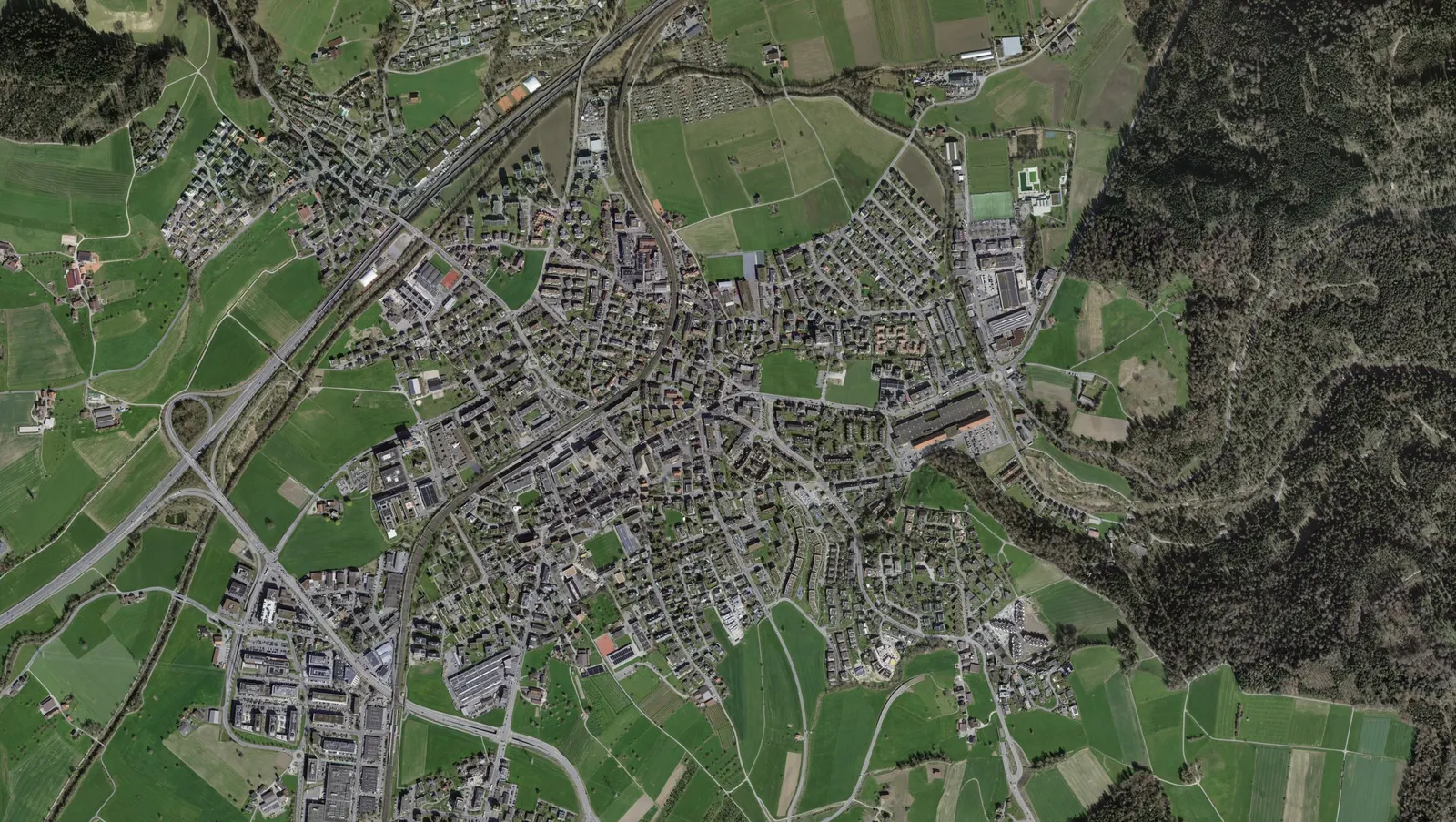
Baar has 25,519 residents (as at 31 December 2025) on 2,485 hectares and is, after the city of Zug, the second-largest municipality in the canton. It lies in the Lorze plain between the Albis and the Zugerberg, borders directly on the city of Zug and is the gateway to Central Switzerland and the link to the Canton of Zurich. Around 32% of the population hold a foreign passport; that is slightly more than in the canton (30.6%) and considerably less than in the city of Zug (37.3%).
What sets Baar apart from every other municipality in Zug is its economic strength: 30,254 people employed in 4,166 businesses (2023), more jobs than residents. Sika, Glencore, Partners Group and Veeam have their headquarters here, as does the Zug cantonal hospital. These companies bring specialists and executives with financing in place to the town, and they are the reason a flat in Baar is also sought after as an investment.
The municipal tax multiplier (Steuerfuss) for 2026 is 47.53% of the simple tax, the lowest in the canton; added to this are the cantonal tax multiplier of 78% and, depending on denomination, church tax of 6.65% (Roman Catholic) or 6% (Reformed). Members of the Baar civic community (Bürgergemeinde) pay a further 2% civic community tax.
Baar station lies on the Zurich–Zug–Lucerne line; the Stadtbahn Zug (S1) runs every 15 minutes via Zug to Cham and Rotkreuz and twice an hour on to Lucerne. Zurich Airport is reached with 70 direct trains a day from Zug and Baar, or by car in a good 45 minutes. Since the opening of the Tangente Zug/Baar bypass in June 2021, through traffic from the Ägeri valley and from Menzingen and Neuheim passes the village and joins the A4 motorway directly; the A14 takes you to Lucerne. For the 2035 expansion step of the railways, an additional platform edge in Baar and adjustments to the Lindenpark and Neufeld stops have been submitted.
The Baar schools are organised in four school districts – Baar-Zentrum, Baar-Nord (Blickensdorf), Baar-Süd (Inwil) and Allenwinden – and teach around 2,300 pupils in nine school buildings in the 2026/27 school year; the Kantonsschule is in the city of Zug. Baar comes alive at the Räbefasnacht carnival, at the Chilbi fair and in more than a hundred clubs and societies, and the town hall with its neo-Renaissance Bürgersaal remains the place where the municipal assembly takes its decisions.
Districts and locations in Baar
Every district has its own market and its own buyers. That is why we do not work with an average price in Baar, but with comparable properties from the same district.
Baar Dorf
The centre around the station, the town hall, the Marktgasse and the church of St. Martin: short distances, shops, the Stadtbahn every quarter of an hour. With the Büelplatz development plan and the Bahnmatt, the centre will change more than any other part of Baar in the coming years.
Flats of all construction years, residential and commercial buildings, apartment buildings as investments.
Inwil
The south, on the boundary with the city of Zug, with the Lindenpark and Neufeld stops. Established neighbourhoods of detached houses and the coming Unterfeld Süd quarter with its 60-metre tower.
Detached houses with gardens, terraced houses, new-build flats from 2028.
Blickensdorf
The north towards Steinhausen and the Knonauer Amt, still village-like, with its own school district and the Baarburg as its local hill. Quiet locations with views over the Lorze plain.
Detached houses, farmhouses with surrounding land, individual apartment buildings.
Allenwinden
The hillside above the Lorzentobel on the way to the Ägeri valley, with its own church of St. Wendelin, its own school and wide views over Baar to the Alps.
Detached houses and villas in elevated positions with views, terraced flats.
Deinikon
The group of farmsteads on the edge of the Lorzentobel between Baar and Allenwinden, surrounded by farmland and forest, a few minutes from the Höllgrotten.
Rare individual locations: farmhouses, country estates, plots with surrounding land.
Walterswil and Sihlbrugg
The north-east on the cantonal boundary with Zurich, with the Sihl and the commercial zone at Sihlbrugg. The fastest route to Zurich, rural yet well connected.
Living combined with business premises, detached houses, commercial properties.
Experience Baar: places that win buyers
Whoever buys in Baar also buys a setting. We name these places in every sales documentation, because they make the difference between an address and a home.
- HöllgrottenDripstone caves in the Lorzentobel, discovered in 1862 during tufa quarrying and opened up from 1885; a tour of around 45 minutes through grottoes with names such as Zauberschloss and Feengrotte. Open from 1 April to 31 October, owned by a family foundation since 1942.
- LorzentobelThe gorge of the Lorze with the old natural stone bridge of 1910 (restored in 2025 for the next 75 years, a monument of national importance), the Schlaufensteg walkway and hiking trails up to the Ägeri valley.
- BaarburgThe wooded table mountain above Blickensdorf, the oldest settlement site in the municipality with finds from the Bronze Age to the early Middle Ages, and a viewpoint over the Lorze plain.
- WildenburgCastle ruin from around 1200 on the ridge between the Lorze and Schwarzenbach gorges, owned by the lords of Hünenberg in 1309, restored on private initiative in 1938 and 1985.
- Church of St. MartinParish church in the village centre with the St. Anna ossuary; the oldest documented church building on this site dates from the early eighth century.
- Spinnerei an der LorzeFactory complex of 1855 with the old mill building, workers' housing, boiler house and power station, the largest surviving nineteenth-century factory building in Switzerland; the Spinni reservoir of 1890 is regarded as one of Baar's most remarkable industrial monuments.
- Town hall and village centreBürgersaal in neo-Renaissance style, Marktgasse, Stadtgarten; the work of the Baar master builder Franz Hotz shapes the townscape to this day.
- Räbefasnacht and ChilbiThe Räbefasnacht is Baar's own carnival, the Chilbi its village fair; both are among the occasions on which Baar shows itself as a village, not a suburb.
How does Rudat AG sell your property in Baar?
Rudat AG has its office at Neuhofstrasse 5A in Baar. We know the districts, the building zones and the buyers; owner Conrad Rudat is your personal contact in Baar.
Valued with the banks' models. Everything starts with a valuation using the IAZI/CIFI models used by Swiss banks. During the visit we check the model value against the condition of the property, the entries in the land register (Grundbuch) and the current transfers of ownership in the region; the result is an asking price (Marktauftrittspreis) that you can justify to co-heirs and banks. The valuation is free of charge and without obligation for owners in Baar.
Marketed like a boutique. Your property receives its own sales documentation with professional photographs, drone footage, floor plans, cadastral plan and a chapter on the municipality of Baar. A 360° virtual tour (in German) allows a first viewing from home and raises the quality of the appointments. The property is listed on the major Swiss portals and in our network of buyers; we conduct the viewings ourselves.
References in the region. In Wettswil am Albis we found new investors for a property within half a day, in Fahrwangen a new-build penthouse flat was reserved after nine weeks, and in Arth on Lake Zug we have marketed a historic estate on the Rigi that has been reserved since October 2026. Our clients rate us on Google with 5.0 stars from 26 reviews; 12 sales are documented, see our references (in German).
- First meeting in Baar, review of the land register extract, plans and mortgage.
- Valuation, asking price, written sales mandate.
- Photographs, drone, 360° virtual tour, sales documentation, listings.
- Viewings, financing check, negotiation, reservation agreement.
- Notarisation, land register entry, handover.
Further reading: the process in detail (in German), the costs in the Canton of Zug and selling property in the Canton of Zug. First meeting: contact us or +41 41 763 33 66.
This text is no substitute for tax or legal advice; on request we involve a fiduciary and the notarising officer.
Sources
Show sources (39, in German)
- Steuerverwaltung Kanton Zug – Steuerfüsse der Gemeinden des Kantons Zug für die Steuerjahre 2023–2026 (PDF, 21.01.2026), retrieved 25.09.2026
- Steuerverwaltung Kanton Zug – Steuerfüsse natürliche Personen, retrieved 25.09.2026
- Gemeinde Baar – Steuern (Steuerfüsse 2025 und 2026), retrieved 25.09.2026
- Fachstelle für Daten und Statistik Kanton Zug – Medienmitteilung «Zuger Bevölkerung wächst weiter – eine Gemeinde sticht heraus» (02.04.2026): Baar +503 Personen, 41 % des kantonalen Wachstums, Ausländeranteile, retrieved 08.10.2026
- Fachstelle für Daten und Statistik Kanton Zug – Ständige Wohnbevölkerung nach Gemeinde, Kanton Zug 1850 bis 2025 (XLSX, Daten BFS), retrieved 25.09.2026
- Fachstelle für Daten und Statistik Kanton Zug – Bevölkerungsstand (Wachstum 2024–2025 je Gemeinde), retrieved 25.09.2026
- Fachstelle für Daten und Statistik Kanton Zug – «Zug in Zahlen 2025» (PDF): Fläche 2’485 ha, Wohnungen 2023 (11’771), Beschäftigte und Betriebe 2023 (BFS STATENT: 30’254 / 4’166), Gebäudebestand 2023 (BFS GWS), retrieved 08.10.2026
- Fachstelle für Daten und Statistik Kanton Zug – Medienmitteilung «Betriebe und Beschäftigte: Zug wächst weiterhin stark» (22.08.2024): Baar 2022 4’091 Betriebe, 28’671 Beschäftigte, +8,4 %, retrieved 08.10.2026
- Kanton Zug – Richtplantext, Stand 27.08.2026, Kapitel G 2.1 (Bevölkerung 2016/2040 je Gemeinde) und G 3.1 (Beschäftigte 2014/2040 je Gemeinde), retrieved 08.10.2026
- Kantonsrat Zug – Interpellation Felber/Meierhans betreffend prognostizierte Zahlenwerte im Richtplan (Vorlage 4158.1, 20.07.2026): Überarbeitung der Prognosen auf Basis des BFS-Szenarios 2025 angekündigt, retrieved 08.10.2026
- nau.ch – «Baar sagt klar Ja zur neuen Ortsplanung» (14.06.2026): 82,5 % Ja, 6’641 zu 1’407 Stimmen, Schwerpunkte der Nutzungsplanung, retrieved 08.10.2026
- Implenia und Property One – Medieninformation «Es geht voran in Baar Süd» (12.07.2022): rund 400 Wohnungen, 1’000–2’000 Arbeitsplätze, 60-m- und 50-m-Hochhaus, rund 90 preisgünstige Wohnungen an Baarer Genossenschaften, drei Etappen, retrieved 08.10.2026
- WSP Schweiz – Quartierentwicklung Baar Süd / Unterfeld Süd: rund 400 Wohnungen, zirka 1’000 Arbeitsplätze, 25 % preisgünstig, 29’000 m² Gewerbe, SNBS, Holzbau, 25 % weniger Parkplätze, retrieved 08.10.2026
- blue News / Keystone-SDA – «Baar voters approve two development plans» (September 2024): Unterfeld Süd 1. Etappe 74 % Ja (19 Geschosse), Marktgasse–Rigistrasse/Büelplatz 82 % Ja (achtgeschossig), retrieved 08.10.2026
- Luzerner Zeitung – «Baar: Grossprojekte Unterfeld und Bahnmatt verändern die Gemeinde» (25.02.2026): 2. Etappe Unterfeld zur Abstimmung im März 2026, Bahnmatt-Planung am Anfang, retrieved 08.10.2026
- zentralplus – «Baar treibt Bau im Unterfeld Süd voran»: Bebauungsplan rechtskräftig, Baustart frühestens Ende 2026, Bezug frühestens 2028, retrieved 08.10.2026
- Immobilien Business – «Baar: Green light for quarter on the Spinnerei site»: 67,1 % Ja, 370 Wohnungen (rund 70 preisgünstig, 80 Familien-, 70 Alterswohnungen), 17’200 m² + 5’000 m² Gewerbe, 495 Parkplätze unterirdisch, Eigentümerin Patrimonium, retrieved 08.10.2026
- zentralplus – «Beschwerde vom Tisch: Spinnerei-Projekt nimmt Fahrt auf»: knapp 400 Wohnungen, Gewerbe und Gastronomie, rund CHF 200 Mio., Baueingabe 1. Etappe in Vorbereitung, retrieved 08.10.2026
- SRF – «Grossprojekt in Baar geplant: Neues Leben in der alten Spinnerei an der Lorze» (28.01.2020): grösstes erhaltenes Fabrikgebäude des 19. Jahrhunderts der Schweiz, 200 m lang, sechs Geschosse, Betrieb bis 1993, retrieved 08.10.2026
- Historisches Lexikon der Schweiz – Artikel «Baar» (Version 08.09.2009): Ersterwähnung 1045, Ortsteile, Baarburg, Wildenburg, St. Martin, Spinnerei 1855, Bahnanschluss 1897, Bevölkerung 1850–2000, retrieved 08.10.2026
- Historisches Lexikon der Schweiz – Artikel «Höllgrotten»: Entdeckung 1862, Erschliessung 1885–1887, weitere Höhlen 1892 und 1902, Familienstiftung seit 1942, retrieved 08.10.2026
- Historisches Lexikon der Schweiz – Artikel «Wildenburg (ZG)»: Bau um 1200, 1309 Hünenberger, Restaurierungen 1938 und 1985, retrieved 08.10.2026
- Höllgrotten Baar – Öffnungszeiten (01.04.–31.10., 9–17 Uhr), Schlaufensteg, retrieved 08.10.2026
- Kanton Zug – Medienmitteilung «Alte Lorzentobelbrücke strahlt in neuem Glanz» (12.05.2025): Bau 1907–1910, Natursteingewölbe, IVS-Objekt von nationaler Bedeutung, Sanierung für 75 Jahre, neue Brücke 1985, retrieved 08.10.2026
- Kanton Zug – Medienmitteilung «Denkmaltage 2026: Baar im Fokus» (18.08.2026): Sternmatt-Grab (rund 5’000 Jahre, älteste bekannte Bestattung des Kantons), Spinnerei, Spinni-Reservoir 1890, Rathaus-Bürgersaal, Baumeister Franz Hotz, retrieved 08.10.2026
- Kanton Zug – Umleitung auf die Tangente Zug/Baar (Inbetriebnahme 24.06.2021), retrieved 08.10.2026
- Kantonsrat Zug – Kantonaler ÖV: Regionale Eingaben zum Ausbauschritt 2035 (zusätzliche Perronkante Baar, Haltestellen Lindenpark und Neufeld), retrieved 08.10.2026
- Fachstelle für Daten und Statistik Kanton Zug – Immobilienmarkt-Cockpit Kanton Zug (Daten Wüest Partner, Stand 1. Quartal 2026, XLSX; Tabellenblätter «Hed. Markt», «Abschluss», «Mengen»), retrieved 25.09.2026
- Fachstelle für Daten und Statistik Kanton Zug – Preise (Übersichtsseite Immobilien- und Baulandpreise), retrieved 25.09.2026
- Fachstelle für Daten und Statistik Kanton Zug – Wohnungen (Leerwohnungsziffer 1. Juni 2026: 0,2 %, 126 Wohnungen), retrieved 08.10.2026
- Bundesamt für Statistik – Medienmitteilung Schweizerischer Wohnimmobilienpreisindex 2. Quartal 2026 (30.07.2026): Gesamtindex +0,7 % zum Vorquartal, +3,5 % zum Vorjahresquartal; Einfamilienhäuser −0,4 %, Eigentumswohnungen +1,6 % zum Vorquartal, retrieved 25.09.2026
- Steuergesetz des Kantons Zug vom 25. Mai 2000 (BGS 632.1), § 170 Bürgergemeindesteuer und §§ 187–202 Grundstückgewinnsteuer, Stand 1. Januar 2026, retrieved 25.09.2026
- Gesetz über den Gebührentarif im Grundbuchwesen des Kantons Zug (BGS 215.35), §§ 4, 13, 14, retrieved 25.09.2026
- Beurkundungsgesetz des Kantons Zug (BGS 223.1), § 4 Abs. 2 und § 7 Abs. 2 (Zuständigkeit der Gemeindeschreiberei für Grundstückkaufverträge), retrieved 25.09.2026
- Eidgenössische Steuerverwaltung ESTV – Dossier Steuerinformationen «Handänderungssteuer» (November 2022, Ziffern 1 und 3.2: ZG nur Grundbuchgebühr), retrieved 25.09.2026
- Gemeinde Baar – Portrait (Lage, sechs Ortsteile, Räbefasnacht, Chilbi, Vereine), retrieved 08.10.2026
- Gemeinde Baar – Öffentlicher Verkehr (Stadtbahn S1, Flughafen Zürich), retrieved 25.09.2026
- Schulen Baar – Übersicht (Schulkreise, Schulhäuser, Schülerzahl 2026/27), retrieved 25.09.2026
- Rudat AG – Referenzen (Wettswil am Albis, Fahrwangen, Arth; Google-Bewertungen, belegte Verkäufe, Käuferanfragen), retrieved 25.09.2026