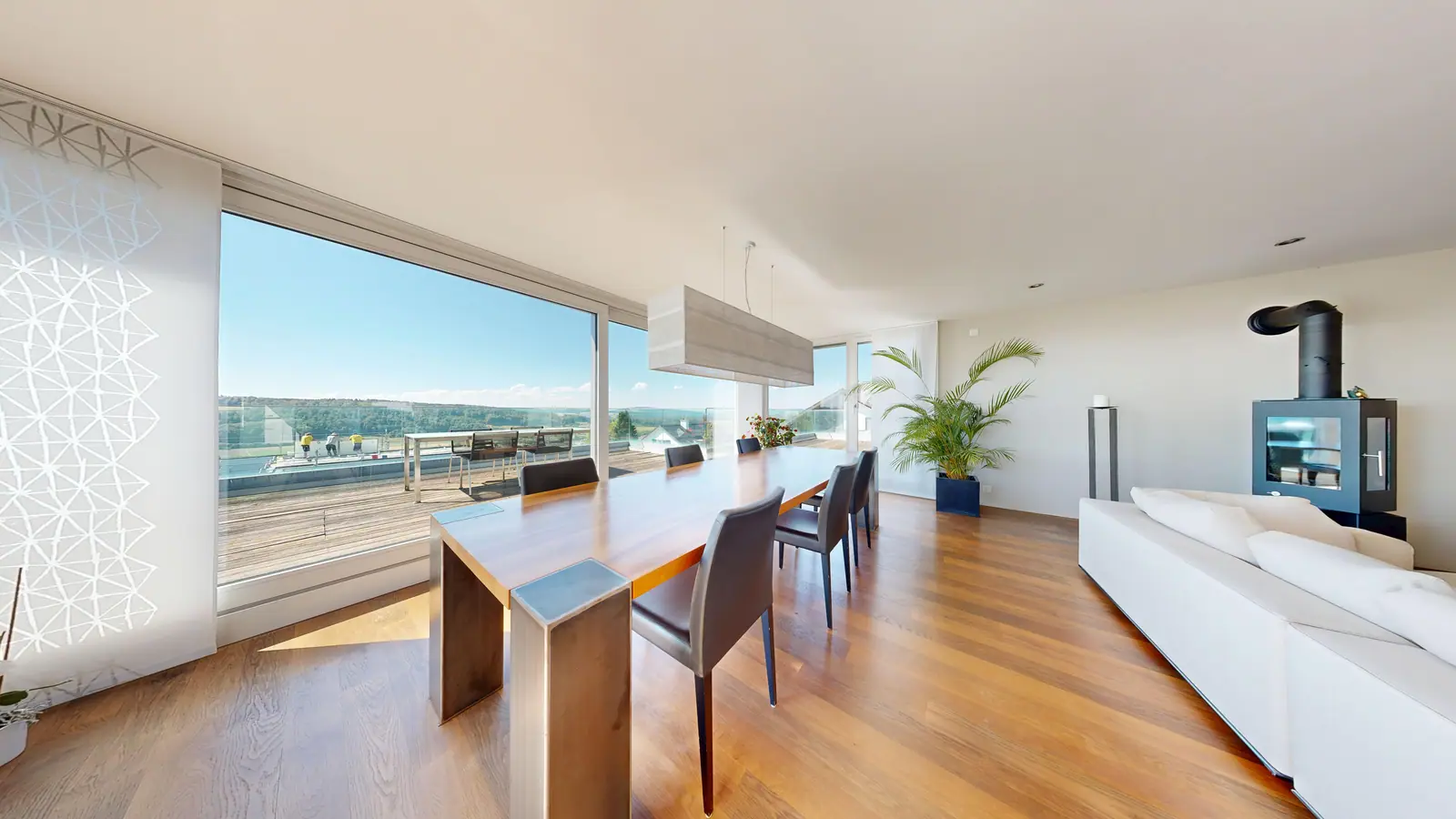
Apartments and detached houses are valued hedonically, apartment and commercial buildings by capitalised earnings value, building land by land value. Market value is decisive (§ 42 of the Zug Tax Act, StG ZG; Art. 14 of the Tax Harmonisation Act, StHG): for banks, the price achievable within one year. Your buyer's bank lends on the lower of purchase price and market value.
Which valuation method suits which property?
The method depends on the property: owner-occupied homes are compared with prices actually paid, investment properties are valued by their income, building land by its land value.
This allocation is the professional standard of the banks. The guidelines of the Swiss Bankers Association require, for owner-occupied residential property, the market value by an adequate method (section 4.4), for investment properties the capitalised earnings value (section 4.5) and, for building land, a valuation based on current market conditions and the future possible use (section 4.7.1).
| Property | Method | What the value is based on |
|---|---|---|
| Apartment, detached house (owner-occupied) | Hedonic comparison method | Purchase prices of comparable transactions, broken down by characteristics |
| Apartment building, commercial building, let residential property | Capitalised earnings method | Capitalised net rental income |
| Villa, unique property, special building | Expert appraisal with intrinsic value and market comparison | Land value plus current value of the buildings, checked against the market |
| Building land | Land value | Market conditions and zone-compliant use |
How does hedonic valuation work?
The hedonic method is a statistical price comparison: it breaks your property down into characteristics and derives from thousands of purchase prices actually paid what each characteristic is worth on the market.
IAZI/CIFI describes the procedure as a comparison method in which the characteristics and purchase prices of thousands of property transactions that actually took place are compared with one another by statistical means. The original wording is quoted in the German version of this guide (in German). Typical characteristics are location (municipality, micro-location, view), living area, number of rooms, year of construction, condition, standard of finish and plot area. Established providers are IAZI/CIFI, Wüest Partner with «Wüest Appraisal» for banks and estate agents, and Fahrländer Partner with the IMBAS models. Who offers which valuation in the canton of Zug, with costs and duration, is shown in the comparison of valuation options in the canton of Zug.
The model has limits: model valuations are permitted only for properties with a sufficient data basis, and properties that are not readily marketable must be valued individually (mortgage lending guidelines, sections 4.1 and 4.2). For a 4.5-room apartment in Baar or Cham the model works well. For the villa on the Zugerberg there are no comparable sales; there the banks dispense with valuation models and value individually, in practice usually with an expert appraisal. As a rule the bank inspects the property. With a model valuation it may dispense with the inspection if the data on the condition are current and documented in a traceable way, for example with photographs (section 4.1).
How is the capitalised earnings value calculated?
The capitalised earnings value is the capitalised, sustainably achievable net rental income: the annual rent without service charges, divided by the capitalisation rate.
The Swiss Bankers Association defines it as the capitalised rental income that can be sustainably achieved in future, calculated on net rents without service charges. The capitalisation rate is made up of a base rate, supplements for operating costs, maintenance and replacement investments, and risk supplements for use, condition, location and the regional vacancy rate. A small difference in the rate moves the value a great deal.
| Worked example (round figures) | Rate 4.0% | Rate 5.0% |
|---|---|---|
| Net rental income per year | CHF 120,000 | CHF 120,000 |
| Capitalised earnings value (income divided by rate) | CHF 3,000,000 | CHF 2,400,000 |
One percentage point in the capitalisation rate makes a difference of CHF 600,000 in this example. That is why, with an apartment building, every hour spent on the tenancy schedule, the service charge accounting and the maintenance records pays off. Not to be confused: for the tax value, the canton of Zug capitalises the gross income at 6 to 8% as a rule (§ 20 para. 2 of the Ordinance to the Tax Act), and at 7% according to the guidance notes of the tax administration. That is a tax value, not a market value.
When does the intrinsic value count and how is building land valued?
The intrinsic value, officially called «Sachwert» in Zug, adds up the land value and the current value of the buildings. It is a control value for properties without a comparison market; for building land only the land value counts.
The cantonal valuation commission (Schätzungskommission) of the canton of Zug defines the intrinsic value as the sum of the current value of the buildings, the surroundings and the relative land value. What a house once cost, however, says little about what buyers pay today. That is why the intrinsic value of villas and special buildings is checked against the market, and otherwise it serves as a control value to make a model or earnings valuation plausible.
For building land the mortgage lending guidelines require a valuation based on current market conditions and the future possible use (section 4.7.1). Decisive are the zone, the permitted utilisation and the servicing of the plot under the building regulations of the municipality, not the square metres alone. An official valuation by the cantonal valuation commission in Steinhausen is not needed for a sale; it serves mainly estate divisions (Art. 618 of the Swiss Civil Code, ZGB), has valued as a matter of principle by the capitalised earnings method since 1 April 2018 and follows the Swiss Valuation Standards in doing so.
What does «market value» (Verkehrswert) mean in law?
«Verkehrswert» and «Marktwert» both mean market value: the price a property is expected to achieve under usual conditions in a free interplay of supply and demand.
Federal law sets the framework: under Art. 14 para. 1 of the Tax Harmonisation Act (StHG), assets are valued at market value, and the capitalised earnings value may be taken into account appropriately. The canton of Zug adopts this for land: under § 42 para. 1 of the Zug Tax Act (StG ZG), the tax value of land corresponds to the market value, and the capitalised earnings value is to be taken into account appropriately. The banks set the time frame: achievable within one year under usual conditions.
A frequent confusion is the tax value from the tax return. According to the guidance notes of the Zug tax administration, the wealth tax value of owner-occupied detached houses and apartments is 75% of the market value for tax purposes. For changes of ownership from 1988 onwards, this is derived from the purchase price at the time plus value-adding investments. As a rule it is only reassessed after a change of ownership, a new building, a value-adding investment, a complete renovation or demolition – or in a general revaluation. Let properties and apartment buildings, by contrast, are valued by the canton on the gross income capitalised at 7%, and the value is reviewed in every tax period.
| Example: owner-occupied detached house (round figures) | Amount |
|---|---|
| Purchase price 2005 | CHF 1,000,000 |
| Market value for tax purposes (purchase price, no investments) | CHF 1,000,000 |
| Wealth tax value (75%) | CHF 750,000 |
| Statement about today's market value | none |
This practice is subject to a reservation: in 2022 the Administrative Court of the canton of Zug held that old valuations left unchanged for years contradict federal law (judgment A 2021 4 of 12 April 2022); the tax administration has announced a revision of the guidance notes, but the version published is still that of 2013.
For the property gains tax, the purchase price together with all further contributions by the buyer counts as the proceeds; where there is no purchase price, where it is obviously too low or where an exchange takes place, the market value at the time of the sale applies (§ 194 para. 1 StG ZG). More in the guide to the property gains tax in the canton of Zug.
How does your buyer's bank value the property?
The buyer's bank values the property itself and finances only the lower of purchase price and market value, the so-called lowest-value principle (Niederstwertprinzip).
That is what the mortgage lending guidelines of the Swiss Bankers Association say (section 4.3.1). Added to this are the minimum requirements for mortgage financing (sections 2.1 and 2.2): at least 10% of the lending value as own funds that do not come from the 2nd pillar, neither as an early withdrawal nor as a pledge. If the purchase price is above the lending value, the difference must be covered entirely from such own funds. The mortgage must be amortised to two thirds of the lending value within 15 years.
| Worked example (round figures) | Price equals bank value | Price above bank value |
|---|---|---|
| Purchase price | CHF 2,000,000 | CHF 2,000,000 |
| Valuation by the buyer's bank | CHF 2,000,000 | CHF 1,800,000 |
| Lending value (lower value) | CHF 2,000,000 | CHF 1,800,000 |
| 10% own funds without 2nd-pillar money | CHF 200,000 | CHF 180,000 |
| Difference between purchase price and lending value, additionally from own funds | CHF 0 | CHF 200,000 |
| Own funds at least, without 2nd-pillar money | CHF 200,000 | CHF 380,000 |
Loan-to-value limits and the affordability calculation are set by each bank internally in addition (sections 3.2 and 4.8). In the example the buyer has to bring almost twice as much free capital.
Why does an asking price that is too high harm the sale?
A price above market value filters out precisely those buyers who need a mortgage, and it lets the listing age in public view.
- The financing collapses. Because of the lowest-value principle, the buyer has to cover the difference to the bank's valuation from own funds. What remains are cash buyers.
- The search alerts do not catch it. Portals show listings only within the price range set. If your price is above it, the right buyers never see the property at all.
- The price reduction is public. Every correction remains visible in the listing history and is read as weakness.
- Time works against you. Market value, by the banks' definition, means achievable within one year. A property that has been listed for considerably longer is read by buyers and banks as a price signal.
The asking price therefore belongs where the buyer's bank will follow, with a negotiating margin that comes from the valuation and not from wishful thinking. What follows after that is shown in the guide to the selling process.
Which documents does a valuation need?
A valuation needs the land register extract, the plans, the building insurance certificate and the list of renovations; for condominium ownership and investment properties the regulations, minutes and tenancy schedule are added. Whatever is missing, the bank estimates cautiously, which means at your expense.
- Land register extract with easements and liens (land registry)
- Cadastral plan and site plan from the official survey
- Building insurance certificate with replacement value and year of construction
- Floor plans, sections and elevations with floor areas, building specification
- List of renovations with year and cost, receipts for value-adding investments
- For condominium ownership: deed of constitution, regulations, minutes of the last three owners' meetings, balance of the renovation fund, service charge statement
- For investment properties: tenancy schedule, tenancy agreements, property accounts of the last three years
- Tax value and imputed rental value according to the last assessment, GEAK building energy certificate if available
Your buyer's bank must document the valuation method and the result in the credit file (mortgage lending guidelines, section 9). For a valuation by Rudat AG we collect these documents before the first appointment.
What this means for your sale
Rudat AG values with the IAZI/CIFI models that Swiss banks use, and checks the result at the property: condition, micro-location, regulations, renovation fund, tenancy schedule. So you know, before the listing goes live, the value the buyer's bank will work with. Our guiding principle: «Valued like a bank. Marketed like a boutique.»
After that we present the property so that the valuation holds: professional photographs, drone footage of the location and grounds, a 360° tour (in German) and a sales brochure with the documents from the list above. Between June and mid-September 2026, 170 buyer enquiries reached us via the portals; 12 documented sales and 5.0 stars from 26 Google reviews can be found under References (in German). We accompany you from the valuation through the negotiation to notarisation before the notary (Selling property in Zug), in the canton of Zug as in Schwyz, Lucerne, Aargau, Zurich, Schaffhausen and Thurgau.
This guide does not replace tax or legal advice. Decisive for the financing is the valuation by your buyer's bank; for tax values, the assessment by your municipality.
Sources
Show sources (13)
- Federal Act on the Harmonisation of Direct Taxation (StHG, SR 642.14), Art. 14 para. 1 (in German), retrieved 25 September 2026
- Tax Act of the Canton of Zug (StG ZG, BGS 632.1), § 42 para. 1, § 194 para. 1, version of 1 January 2026 (in German), retrieved 25 September 2026
- Ordinance to the Tax Act of the Canton of Zug (BGS 632.11), § 20 para. 2 (capitalised earnings value: gross income capitalised at 6 to 8% as a rule) (in German), retrieved 25 September 2026
- Federal Tax Administration (ESTV), cantonal sheet Zug (as at February 2026), valuation of assets, § 42 StG and § 20 StGV (in German), retrieved 25 September 2026
- Zug cantonal tax administration, guidance notes «Festsetzung der Vermögens- und Eigenmietwerte» (guidance notes on property taxation, as at October 2013), sections 3, 4 and 11: wealth tax value 75% of the market value for tax purposes for owner-occupied residential property, derivation from the purchase price for changes of ownership from 1988, grounds for reassessment, gross income of let properties capitalised at 7% (in German), retrieved 25 September 2026
- Administrative Court of the Canton of Zug, judgment A 2021 4 of 12 April 2022 (wealth tax value of an apartment), consideration 4 (in German), retrieved 25 September 2026
- Canton of Zug, cantonal valuation commission: valuation of non-agricultural land (definition of intrinsic value, capitalised earnings method since 1 April 2018, Swiss Valuation Standards, § 3 para. 1 EG ZGB, Art. 618 ZGB) (in German), retrieved 25 September 2026
- Swiss Bankers Association, guidelines on the examination, valuation and processing of mortgage-secured loans (December 2023, in force since 1 January 2025), sections 3.2, 4.1 to 4.8, 9 and glossary (in German), retrieved 25 September 2026
- Swiss Bankers Association, guidelines on minimum requirements for mortgage financing (December 2023, in force since 1 January 2025), sections 2.1 and 2.2 (in German), retrieved 25 September 2026
- IAZI/CIFI, hedonic valuation (definition of the method) (in German), retrieved 25 September 2026
- Wüest Partner, Wüest Appraisal – hedonic valuation of property (in German), retrieved 25 September 2026
- Fahrländer Partner Raumentwicklung, valuation (IMBAS) (in German), retrieved 25 September 2026
- Swiss Civil Code (ZGB, SR 210), Art. 618 (valuation in estate division) (in German), retrieved 25 September 2026
This guide does not replace tax or legal advice. The assessment of your municipality is decisive.